
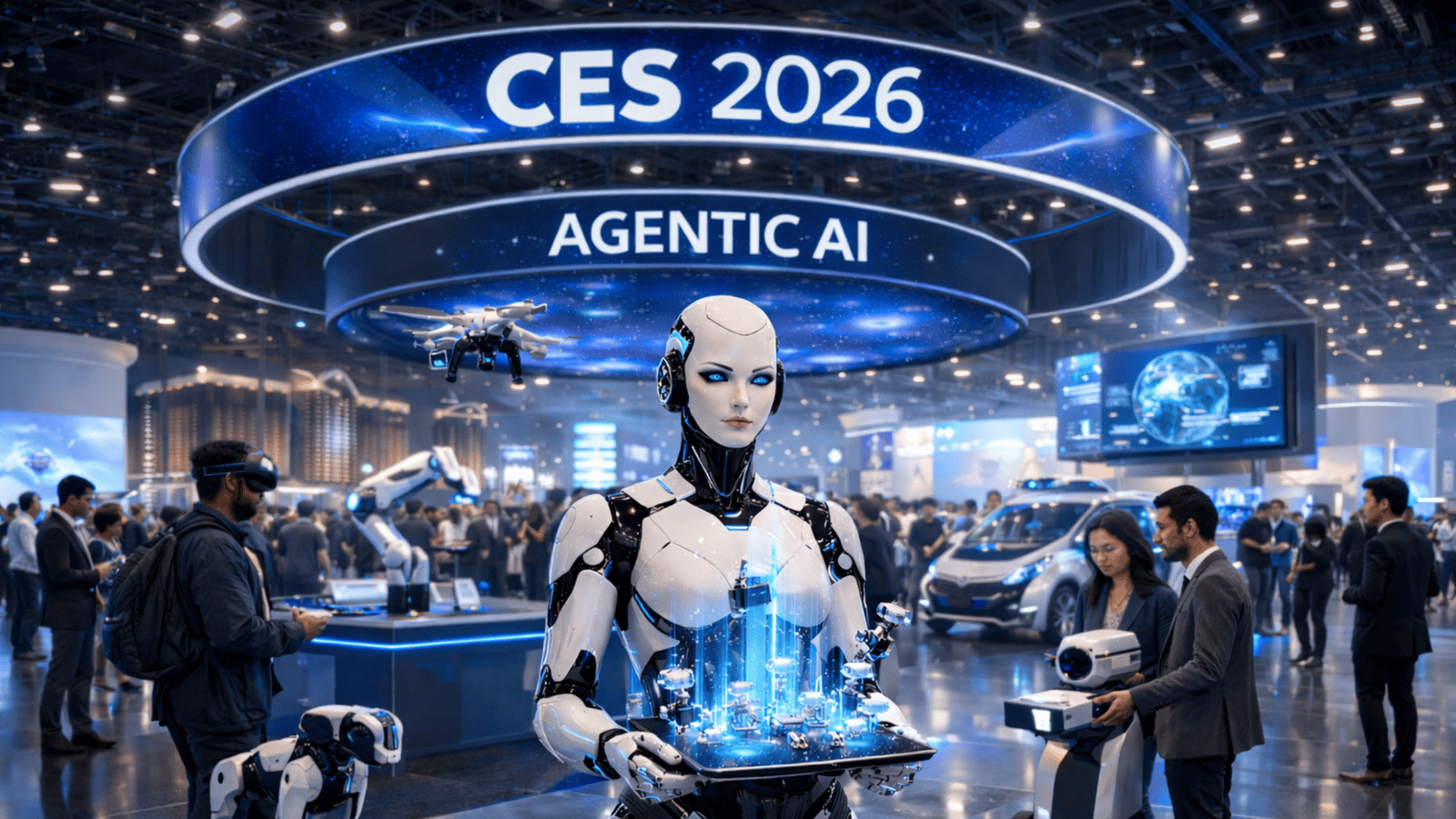
CES has historically been a showcase for emerging technology. CES 2026 is different. The dominant signal this year is not experimental AI or creative demos—it is the operationalization of artificial intelligence inside real business systems.
Across the show floor, the pattern is consistent: AI is moving from standalone tools into embedded, decision-making components of everyday workflows.
This shift has direct implications for small and mid-sized businesses.
The end of AI as a "feature"
In previous years, artificial intelligence was often presented as an add-on: a chatbot, a recommendation engine, or a creative assistant layered onto existing software.
At CES 2026, AI is increasingly presented as infrastructure.
Instead of asking users to interact with AI, vendors are designing systems where AI operates continuously in the background—monitoring, routing, summarizing, and triggering actions without manual input.
This marks a transition from:
AI tools → AI systems
User prompts → autonomous execution
Dashboards → agents
Agentic AI is the real story
The most consequential development at CES is the rise of agentic AI—software agents capable of completing multi-step tasks across applications with limited human intervention.
Examples seen across platforms include:
AI agents that monitor data and trigger workflows automatically
Systems that coordinate scheduling, communications, and follow-ups
Tools that synthesize information across departments instead of siloed reports
This matters because businesses do not scale on insights alone. They scale on execution.
Agentic AI shifts the role of human teams from managing processes to supervising outcomes.
Why this matters for small and mid-sized businesses
The most consequential development at CES is the rise of agentic AI—software agents capable of completing multi-step tasks across applications with limited human intervention.
Examples seen across platforms include:
AI agents that monitor data and trigger workflows automatically
Systems that coordinate scheduling, communications, and follow-ups
Tools that synthesize information across departments instead of siloed reports
This matters because businesses do not scale on insights alone. They scale on execution.
Agentic AI shifts the role of human teams from managing processes to supervising outcomes.
From awareness to implementation
CES highlights what is possible. It does not solve implementation.
Most businesses face the same constraints:
Existing software stacks
Fragmented data
Legacy processes
Limited internal technical resources
The real work begins after the event—mapping AI capabilities onto actual business operations in a way that is secure, measurable, and aligned with business goals.
The role of AI-First system design
An AI-first approach does not mean replacing people or rebuilding everything from scratch. It means designing systems where AI is assumed to be an active participant in workflows from day one.
This includes:
Defining where decisions can be automated
Identifying processes that benefit from continuous monitoring
Establishing human-in-the-loop controls
Measuring outcomes, not activity
This is where strategy, systems thinking, and execution converge.
Looking ahead
CES 2026 confirms that the AI conversation has matured. The focus is no longer on whether AI works, but on how it is deployed responsibly and effectively inside real organizations.
For businesses, the question is no longer if AI will reshape operations, but who will implement it first—and who will fall behind managing outdated workflows.
ChavisTec focuses on helping organizations transition from AI experimentation to AI-driven operations by designing systems that turn emerging technology into practical business advantage.
Next
This week, we will break down how businesses can translate CES AI trends into actionable systems without disrupting existing operations.